Loading
Loading
Loading
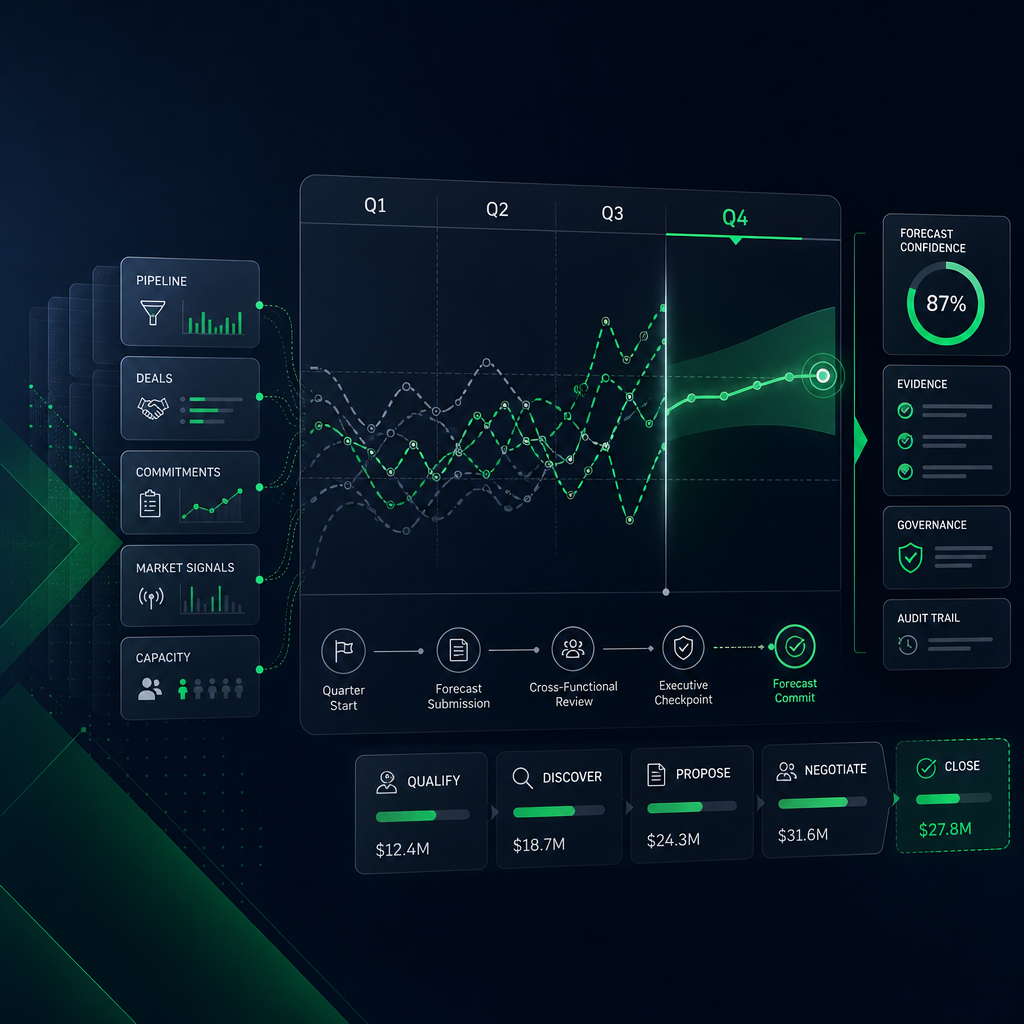
Late-quarter forecast swings usually aren't a forecasting problem. They're a governance gap between what sales booked and what delivery can actually execute.
If your forecast holds steady for weeks and then lurches in the final days of the quarter, the problem usually isn't your forecasting method. It's that the forecast was never built on operational truth in the first place. It was built on CRM stage, and CRM stage measures sales momentum, not whether the revenue is real, deliverable, and defensible.
The late-quarter swing is the moment reality catches up with optimism. Here's why it happens, and what actually fixes it.
Most forecasts are assembled from CRM stage and probability weighting. A deal marked "Negotiation, 75%" contributes 75% of its value to the number. That feels rigorous. It isn't, because stage tells you how far the sales conversation has progressed, not whether the rest of the company can actually deliver what was sold.
So a deal can sit at 75% for weeks, propping up a confident forecast, while three things quietly remain true: no delivery project exists for it, no capacity has been allocated, and no one has validated that the close date is realistic. The forecast looks stable because nothing has forced those facts to the surface. Then, in the last two weeks of the quarter, someone finally asks the operational questions, and the number moves.
A deal marked high-probability and near-close often has no delivery project behind it, no resource plan, no kickoff date, no scope validation. As long as it lives only in the CRM, it counts as forecast revenue. But if it closes and delivery can't start, revenue recognition slips into the next quarter anyway. The booking was real; the recognized revenue was fiction. That gap only becomes visible when someone checks delivery readiness, usually too late to fix.
Deals sail past their committed close date and simply stay in the pipeline, still open, still weighted, still counted. "Overdue" becomes normal instead of a trigger for a decision. Every one of those deals is a decision someone avoided, dressed up as revenue still expected. When the quarter closes and they don't, the forecast corrects downward all at once.
Even when deals are real and closing, the business can only recognize the revenue if delivery can execute. If near-term bookings exceed delivery capacity, some of that revenue is going to slip no matter how good the sales process was, because you can't recognize what you can't deliver. Forecasts built on stage weighting never see this constraint. It shows up as a surprise.
Underneath all three is a single structural problem. Your revenue lives in systems that don't talk to each other. Sales books it in the CRM. Delivery executes it somewhere else. Finance recognizes it in a third place. Each holds a piece of the truth, and none of them agree. The forecast is stitched together from all three, usually by hand, usually once a quarter, usually after the gap has already cost you.
Late-quarter volatility is what it looks like when those systems finally get reconciled under deadline pressure instead of continuously. The number was always going to move; the only question was whether you found out with time to act or found out at quarter-close.
You don't fix late-quarter swings by forecasting more often or adding another probability model on top of the same CRM data. You fix it by governing the forecast against operational reality before you report it, the same way you'd govern capital, with controls and accountability rather than optimism.
Concretely, that means a few disciplines most revenue orgs don't have:
Here's the question that separates a governed forecast from an optimistic one: can you say, with evidence, why your forecast is what it is, and which parts of it you could defend if your board asked "how do you know"?
If the honest answer is "the CRM says so," your forecast will keep changing late in the quarter, because the CRM is only ever telling you what sales believes, not what the company can actually deliver, bill, and recognize. Governing the seam between them is what turns a number that swings into a number you can stand behind.
Want to know how much of your current forecast is built on operational truth versus CRM optimism? Run the revenue governance assessment →
An Executive Briefing starts with the same question this article does — ask it about your own operation.
Book an Executive Briefing →