Loading
Loading
Loading
Tool sprawl fragmented the operating model. AI sprawl fragments the decisions themselves — and it stays invisible until someone asks the same question to three different people and gets three different answers.
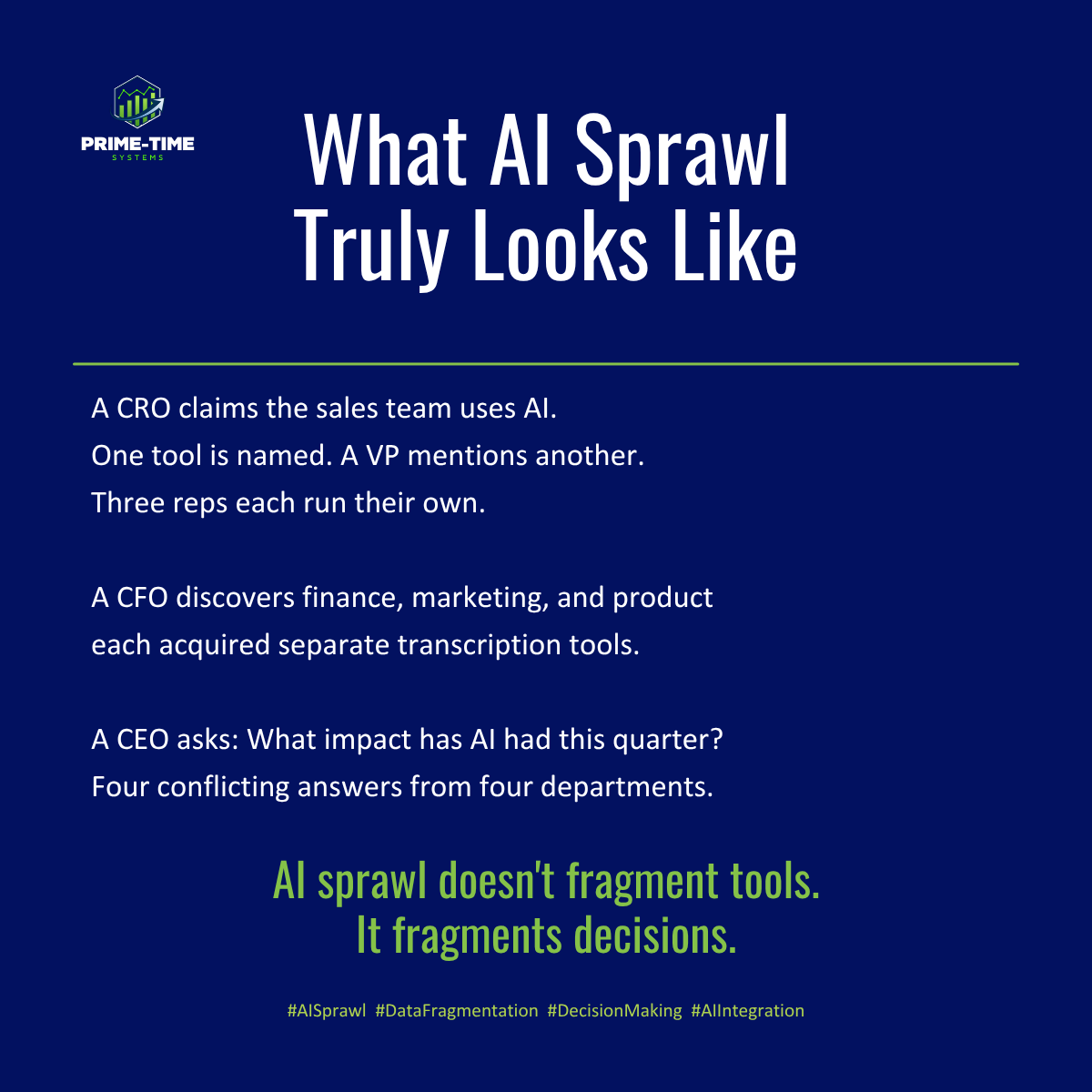
A VP of Sales tells the board the sales team is using AI. Ask which tool, and you get a different answer depending on who's in the room, one name from the VP of Sales, a different one from a regional VP, and three reps who each run something else entirely. Nobody's lying. Nobody even notices there's a problem, until a Controller or CFO discovers finance, marketing, and product each quietly bought their own transcription tool, or an Owner, President, or CEO asks a straightforward question (what impact has AI had this quarter) and gets four conflicting answers from four departments.
That's what AI sprawl actually looks like from the inside. It rarely announces itself as a crisis. It shows up as a slow accumulation of small, reasonable-looking decisions that nobody connected to each other.
Tool sprawl is a familiar problem: too many point solutions, overlapping licenses, nobody sure which system is the source of truth. It's expensive and annoying, but it's a systems problem. You can usually see it in a spend audit.
AI sprawl is a different kind of problem, because the thing that fragments isn't a system. It's a decision.
Every one of those separately-adopted AI tools is quietly shaping how someone on the team decides what to do next, what to say on a call, what to flag as a risk, what to report up. When five people are getting five different flavors of AI-assisted judgment, with no shared view of what any of them are actually being told, the organization doesn't have an AI strategy. It has five slightly different organizations operating under one name.
The reason this pattern survives so long inside otherwise well-run companies is that each individual adoption decision looks fine in isolation. A rep picks up a call-coaching tool because it made their week easier. A regional VP approves a different one for the same reason. Nobody's evaluating whether these tools agree with each other, because nobody's job is to ask that question, until the day someone tries to get one consistent answer out of the business and can't.
This is the same failure mode revenue governance exists to catch in other forms: a system that produces technically-true answers from five different vantage points, with no single place where those answers reconcile. What is revenue governance walks through why that reconciliation step (not more data, not more dashboards) is the actual gap in most growth-stage operating models. AI sprawl is that same gap, just showing up in a newer wrapper.
Governing AI adoption doesn't mean slowing teams down with an approval committee for every tool. It means making three things true that most organizations currently can't claim:
One inventory, reviewed on a cadence. Not a static list from a rollout six months ago, but an actual current picture of what's in use, by whom, and why. If leadership can't answer "what AI tools touch a customer-facing decision this quarter," that's the first gap to close.
A shared definition of what the tools are actually being asked to do. Two tools solving "help reps write better follow-up emails" is a minor redundancy. Two tools independently deciding what counts as a qualified lead is a governance problem, because they're making a business judgment, not just saving time.
A single point where conflicting outputs get reconciled. When two AI-assisted views of the same account disagree, someone (a person, not another tool) needs to own resolving that disagreement before it reaches a forecast, a board deck, or a customer.
This is the same discipline Accountable AI for revenue decisions requires more broadly: the goal isn't to slow down AI adoption, it's to make sure the business can trust and explain what its AI-assisted decisions actually are. Tool sprawl and revenue risk covers the systems-level version of this same pattern, worth reading alongside this piece, since AI sprawl is largely tool sprawl's more consequential successor.
If you're not sure where your organization stands, the fastest honest test is the one buried in the scenario above: ask your VP of Sales, a regional VP, and three individual reps the same question ("what AI tools are you using for X, and what are they telling you?") and see how many different answers come back. The gap between those answers is a reasonably accurate measure of how much of your AI adoption is currently ungoverned.
That's not a reason to panic, and it's not a reason to freeze AI adoption until there's a perfect framework in place. It's a reason to build the reconciliation point before the sprawl compounds any further, because the cost of AI sprawl isn't the licenses. It's the decisions made on five different versions of the truth, each one looking perfectly reasonable until they're compared.
An Executive Briefing starts with the same question this article does — ask it about your own team.
Book an Executive Briefing →