No matter what industry you’re in, growth creates a predictable cycle:
- You scale
- Complexity explodes
- You invest in technology to keep up
At first, those investments feel like leverage.
A CRM to manage pipeline.
A billing system to support new pricing.
A warehouse to unify reporting.
A customer success platform to reduce churn.
A product analytics tool to understand usage.
But as the business grows faster, the stack grows wider.
And eventually, the tools you bought to enable growth start creating a different problem:
fragmentation.
Growth Forces Technology Investment — and Technology Creates Fragmentation
Scaling businesses don’t buy tools because they want complexity.
They buy tools because they need capability.
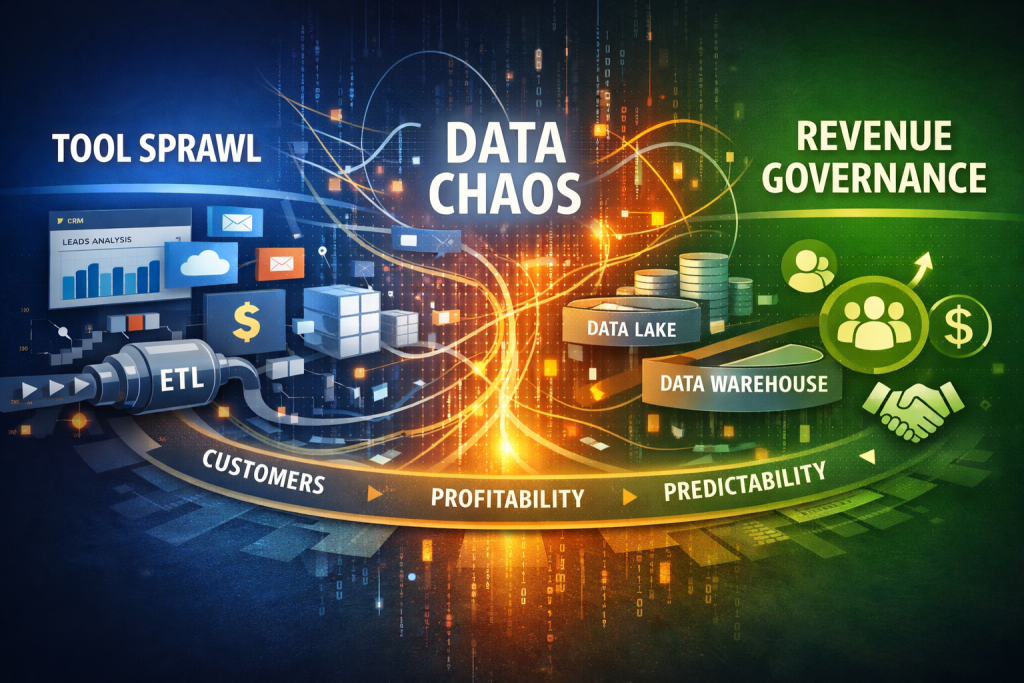
But over time, tool sprawl forms into a comprehensive stack of (mostly necessary) utilities — each built for a functional purpose, each producing its own version of the truth.
That’s when a second reality sets in:
Your data starts living in many different languages and systems.
- Sales data lives in CRM objects and stages
- Finance data lives in billing, ERP, and spreadsheets
- Delivery data lives in project tools and time tracking
- Customer data lives in support platforms and product telemetry
- Leadership data lives in dashboards that summarize everything imperfectly
And the organization slowly becomes a federation of systems—not a single company running a single story.
The Middleware Era Returns (Again)
When tool sprawl hits a certain point, companies face the same decision:
Invest in middleware to stitch the stack together.
So they build pipelines to extract data from data lakes and warehouses.
They add integration layers.
They pay for ETL tools.
They create new RevOps and data engineering roles.
They attempt to unify insights across fragmented systems.
And while this often improves reporting…
It rarely improves execution.
Because connecting data is not the same as governing decisions.
AI Is Making Data Extraction Faster — But Governance Is Still Missing
This is where AI changes the game.
Today, AI can:
- pull insights from unstructured data
- summarize calls, tickets, and transcripts
- find patterns across accounts
- answer questions instantly across knowledge sources
- generate forecasts and predictions quickly
Extraction has accelerated.
But there’s still a pervasive gap:
governance.
Even if AI can tell you what’s happening, it doesn’t automatically create:
- a shared interpretation across teams
- a consistent operating rhythm
- enforceable decision standards
- an end-to-end view of what a deal means operationally and financially
So organizations are now in a new era of speed:
The organization can move faster than it can align.
And that creates risk at scale.
The Core Problem: Revenue Complexity Has Outpaced Governance
This isn’t a data problem.
It’s a revenue governance problem.
Revenue execution used to be simpler:
- fewer stakeholders
- fewer products
- fewer deal structures
- clearer delivery boundaries
Now, complexity is the norm.
Longer deal cycles, more stakeholders
Enterprise deals involve legal, security, finance, procurement, IT, and multiple business owners.
Every additional stakeholder introduces:
- new constraints
- new approval paths
- new failure points
- more room for misalignment
Hybrid delivery models under margin pressure
Many companies now deliver through a hybrid model:
- internal teams + partners
- services + product
- onboarding + ongoing support
- custom + standard offerings
This makes execution harder and margin easier to erode.
A deal can look profitable in the CRM and still become unprofitable in delivery.
Stakeholders demand predictability and comparability
As companies mature, leadership expectations change.
You can’t manage a $10M business the same way you manage a $100M business.
Executives and boards require:
- predictability
- repeatability
- comparability across segments
- confidence in execution risk
- margin durability
But most stacks can’t explain outcomes consistently because the system isn’t unified.
AI accelerates decisions without execution context
AI is increasing velocity in revenue workflows:
- faster prospecting
- faster proposal generation
- faster negotiation cycles
- faster internal approvals
- faster forecasting
But when decisions accelerate without execution context, you don’t get compounding growth.
You get compounding risk.
The organization starts closing deals faster than it can deliver them cleanly.
Why “More Tools” Won’t Fix This
At a certain stage, investing in more systems becomes diminishing returns.
Because the issue isn’t the lack of tools.
It’s the lack of a governing layer that answers:
- Is this deal executable?
- Is it profitable after delivery?
- What risks are we accepting—and why?
- What does delivery need to succeed?
- What does finance need to protect margin?
- What does leadership need to see early?
Dashboards can’t answer those questions reliably if they’re built on disconnected assumptions.
AI can’t answer those questions reliably if the company doesn’t have shared standards.
What scaling companies need is not more insight.
They need one story.
One Story Is the Missing Requirement
Most organizations don’t suffer from lack of information.
They suffer from lack of alignment around what the information means.
Sales sees opportunity.
Delivery sees risk.
Finance sees exposure.
Leadership sees surprise.
And when each team has a different story, execution becomes negotiation.
That’s when you start seeing:
- late-stage escalations
- margin compression post-sale
- forecast volatility
- customer dissatisfaction
- constant “fire drills”
- leadership decisions made with incomplete visibility
All because the governing system doesn’t exist.
PRIME Systems: A New Category for Revenue Governance
PRIME Systems is creating a unique category designed for what matters most:
your customers, your revenue, and your growth.
Not by adding another tool to the pile.
But by solving the missing layer: revenue governance that connects the business end-to-end.
A governance-first system ensures that as your tech stack grows, your company doesn’t fragment.
It connects:
- sales decisions to delivery feasibility
- delivery execution to financial performance
- financial outcomes to leadership visibility
- customer experience to long-term growth
Because at scale, the winners aren’t the companies that collect the most data.
They’re the companies that can govern the story their data is telling.
The Competitive Advantage in the AI Era: Governance at Speed
AI is accelerating the pace of business.
Which means the cost of misalignment is rising faster than ever.
The companies that win in this next era won’t just be faster at extracting insights.
They’ll be faster at aligning the organization around what matters—and executing with clarity.
Because the next frontier isn’t better reporting.
It’s governed execution.
And that’s what PRIME Systems is built to deliver.