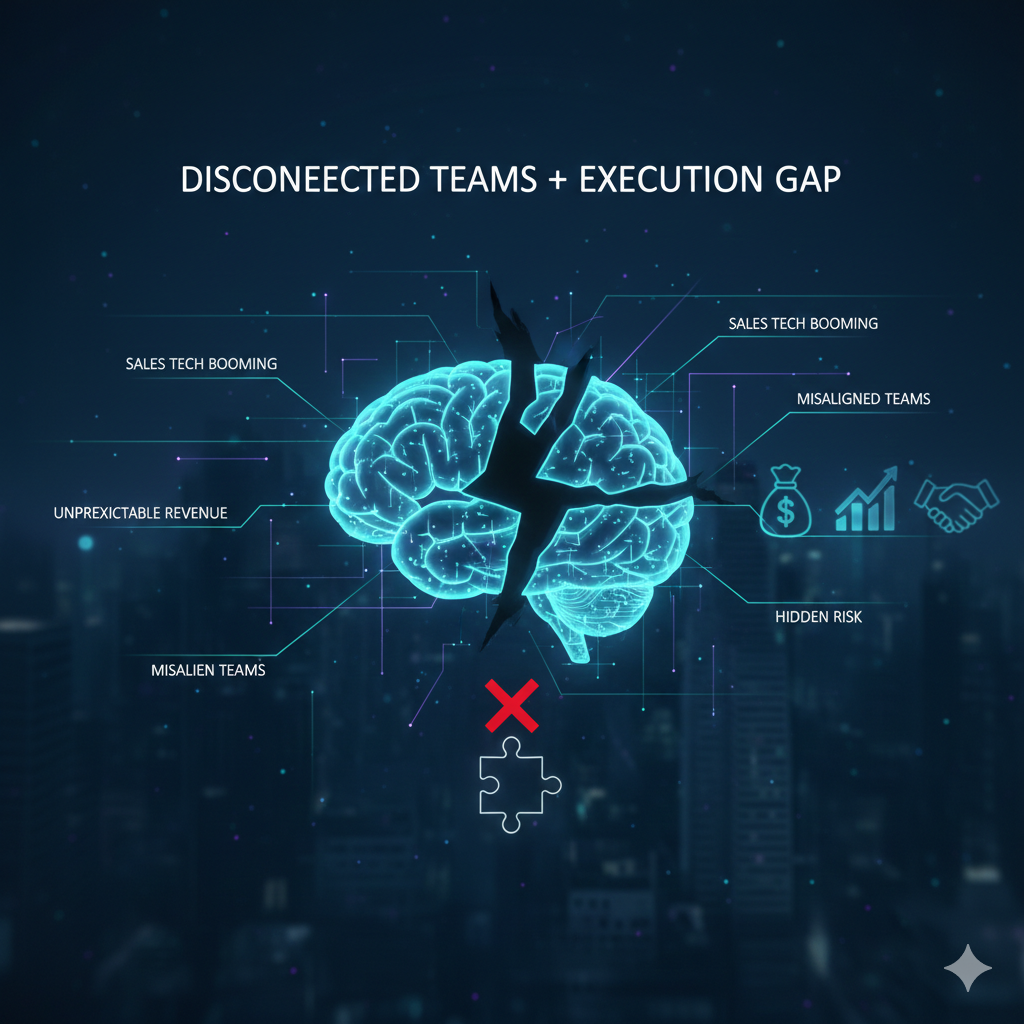
Disconnected Revenue Teams: Why Sales Technology Isn’t Fixing Revenue Execution
Revenue teams have never had more technology.
CRMs, sales engagement platforms, RevOps dashboards, forecasting tools, and AI-powered revenue intelligence are now standard. Companies are investing record amounts in modern sales tools, data infrastructure, and automation.
And yet revenue execution is still unpredictable.
Deals close without executable clarity. Margins erode after the contract is signed. Delivery teams inherit risk they didn’t shape. Finance measures impact after value is lost. Leadership is surprised by problems they never saw coming.
This isn’t always a selling problem.
It’s often the absence of a governing system that connects sales decisions to delivery outcomes, financial performance, and leadership visibility.
As revenue complexity increases and AI accelerates decision-making, the cost of poor execution is rising faster than growth.
What Is Revenue Execution (and Why It Breaks in Modern Organizations)?
Revenue execution is the end-to-end ability to translate a sales decision into successful delivery, customer outcomes, and profitable financial results.
Most companies assume revenue execution happens naturally once a deal is closed.
In reality, execution breaks when teams operate with disconnected systems and incentives:
-
Sales optimizes for bookings and closed-won
-
Delivery optimizes for feasibility and capacity
-
Finance optimizes for margin and cash flow
-
RevOps optimizes for forecasting and reporting
-
Leadership optimizes for growth and predictability
Individually, each function may perform well.
Collectively, the organization becomes misaligned because no system owns the outcome end-to-end.
The Root Cause: Organizational Dependencies Are Missing From the Revenue System
Most revenue organizations have great tools inside each function.
What they don’t have is a system that governs the dependencies between functions.
This is the gap that causes predictable failure patterns:
-
The deal is “sold” but not executable
-
Commitments are made without delivery input
-
Pricing and scope create unplanned cost-to-serve
-
Risk is discovered late, when it’s expensive
-
Forecasting becomes reactive, not preventative
Technology optimizes the function.
But revenue execution requires connecting the organization.
Why Revenue Execution Remains Unpredictable Despite Sales Tech and AI
Even with modern technology, revenue execution breaks because most systems stop at the wrong boundary.
CRM systems optimize sales activity but stop at closed-won
CRMs are built to track pipeline stages, activities, and next steps.
But most CRM workflows stop providing structure once the deal is marked closed-won.
That means there’s no enforced requirement for:
-
delivery readiness
-
scope clarity
-
cost-to-serve visibility
-
margin protection
-
risk governance
Closed-won becomes a finish line instead of a handoff.
RevOps tools report forecasts after decisions are made
Forecasting platforms and RevOps dashboards provide visibility into pipeline health and risk signals.
But reporting isn’t governance.
Most forecasting tools describe what’s likely to happen after decisions are already made, including:
-
deal terms
-
implementation timelines
-
discounting
-
resourcing assumptions
Forecasting becomes a rearview mirror when the business needs a steering wheel.
Consulting aligns leadership temporarily, but the operating model doesn’t change
Many organizations bring in consulting support to improve cross-functional alignment.
It works—briefly.
But alignment doesn’t sustain without an operating system that makes decisions repeatable and enforceable.
When the engagement ends, the org typically returns to:
-
informal handoffs
-
ungoverned exceptions
-
decisions made under deadline pressure
-
“we’ll fix it in delivery” behavior
Delivery inherits risk it didn’t shape
Delivery teams often become the default owners of execution risk.
They inherit:
-
unclear scope
-
nonstandard terms
-
unrealistic timelines
-
missing documentation
-
unsupported product promises
This is one of the biggest hidden drivers of:
-
margin leakage
-
customer dissatisfaction
-
implementation delays
-
escalation and churn
Finance measures margin impact after the value is lost
Finance can explain margin erosion with precision.
The problem is timing.
Finance often sees margin impact after:
-
discounting is approved
-
custom terms are committed
-
delivery complexity is locked in
At that point, recovery is expensive—or impossible.
Signs Your Revenue Organization Has a Revenue Execution Problem
If your company experiences any of these, you likely have a systemic revenue execution gap:
-
Strong pipeline, but unpredictable outcomes
-
Frequent “surprise” delivery escalations
-
Discounts increase, but profitability falls
-
Forecasts change suddenly late in the quarter
-
Deals close, but onboarding fails or slips
-
Post-sale teams feel like they’re cleaning up sales commitments
-
Leadership has visibility into activity, not execution risk
Why This Problem Is Getting Worse in 2026: Complexity + AI
Revenue execution problems are compounding because of three major trends:
1) Revenue models are more complex
Modern revenue includes:
-
usage-based pricing
-
bundles and packaging variations
-
custom contracts
-
multi-product deals
-
enterprise security and compliance requirements
-
partner delivery dependencies
Complexity increases the number of “failure points” per deal.
2) Delivery capacity is tighter
Even great delivery teams can’t absorb unlimited risk.
As services become specialized and customer expectations rise, delivery teams need earlier involvement, clearer commitments, and fewer surprises.
3) AI accelerates sales decisions
AI is speeding up the top of the funnel:
-
faster outreach
-
faster responses
-
faster qualification
-
faster proposals
-
faster negotiation cycles
But faster decisions without governance create faster misalignment.
AI multiplies sales motion. Without connected revenue execution, it also multiplies risk.
The Solution: A Governing System That Connects Sales to Delivery and Finance
The fix isn’t “more sales tools.”
The fix is a revenue execution operating system—a governing layer that connects decisions across teams before commitments are made.
A connected system creates:
Shared decision standards
-
What qualifies as an executable deal
-
What requires delivery validation
-
What terms trigger financial review
-
What risk thresholds require leadership approval
Built-in cross-functional workflows
-
sales-to-delivery handoff requirements
-
pricing and margin guardrails
-
scope and timeline validation
-
customer outcomes alignment
Leadership visibility into execution risk
Not just:
-
pipeline coverage
-
forecast category
-
sales activity
But also:
-
delivery feasibility
-
margin exposure
-
resourcing constraints
-
contract exceptions
-
customer risk flags
Feedback loops that prevent repeat failures
Instead of learning after things go wrong, the system feeds outcomes back into upstream decisions:
-
delivery reality informs sales commitments
-
margin impact informs pricing behavior
-
churn risk informs qualification criteria
The Competitive Advantage: Connected Revenue Execution
Most companies still invest as if the goal is better selling.
But modern growth isn’t constrained by selling alone.
It’s constrained by execution integrity.
The companies that outperform won’t be the ones with the most tools.
They’ll be the ones with the best governing system—connecting sales decisions to delivery outcomes, financial performance, and leadership confidence.
Because revenue isn’t won when a deal closes.
Revenue is won when that deal delivers profitably.