Modern organizations aren’t struggling because they lack tools.
They’re struggling because they have too many tools that don’t connect.
CRMs track pipeline activity. Accounting platforms measure financial outcomes. Project management systems run delivery. Data warehouses centralize reporting. AI surfaces insights faster than ever.
And yet, revenue execution still breaks in the same places:
- Deals close without executable clarity
- Delivery inherits commitments it didn’t shape
- Margins erode after the sale
- Forecasts look “accurate” until reality hits
- Leadership discovers risk too late
The problem isn’t capability.
It’s governance.
And point solutions weren’t built to govern the full commercial lifecycle.
Point Solutions Are Great at Functions—But Not Outcomes
Most platforms are engineered to win inside a single domain:
- Accounting systems excel at measurement and compliance
- CRM tools excel at tracking pipeline stages and activity
- RevOps reporting tools excel at dashboards and forecasting
- Project management platforms excel at execution tracking
- Data lakes and warehouses excel at aggregation
These tools are essential.
But they share a limitation: they optimize local workflows, not end-to-end outcomes.
That’s why businesses can invest heavily across the stack and still experience fragmentation.
Because each system tells part of the story—but no system owns the complete story.
The Real Gap: A Unified Commercial Lifecycle
What’s missing is not another tool.
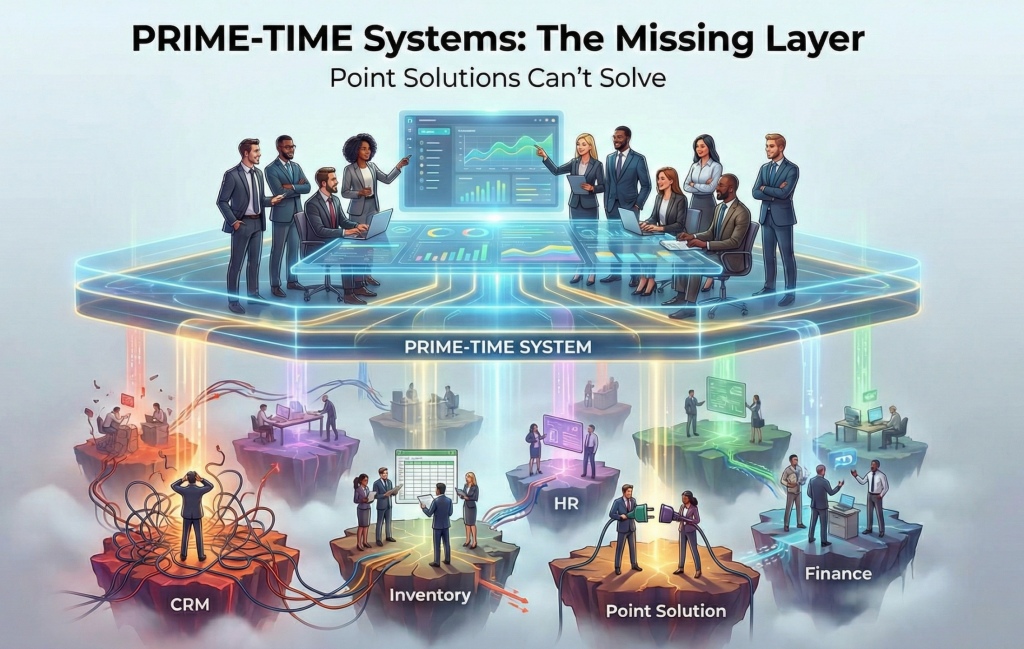
What’s missing is a unified operating system that connects the entire commercial lifecycle:
customer engagement → sales execution → revenue impact → modeling → delivery outcomes
This is the gap PRIME-TIME Systems fills.
PRIME-TIME Systems is purpose-built to unify the commercial lifecycle into one mission-critical system—so decisions made upstream don’t become surprises downstream.
PRIME-TIME Systems Fills the Gap Left by Disconnected Platforms
PRIME-TIME Systems isn’t trying to be a better CRM, finance tool, or delivery tracker.
It’s designed to orchestrate what those tools can’t do alone:
Customer engagement with execution context
Customer engagement is often measured by interactions—emails, meetings, calls, pipeline progression.
PRIME makes engagement actionable by connecting it to what matters next:
- executable deal structure
- delivery readiness
- margin implications
- customer outcome alignment
Sales execution that governs commitments
Most sales tools accelerate activity.
PRIME governs decisions.
It creates structure around the moments where deals become expensive:
- discounting
- scope definition
- delivery assumptions
- nonstandard terms
- timing commitments
Instead of “closing the deal,” the system enforces “closing the right deal.”
Revenue impact and financial outcomes tied to the deal
Most finance teams measure margin after the fact.
PRIME links revenue and margin impact to the decisions creating it—early enough to do something about it.
This is where predictable growth is protected:
- cost-to-serve visibility
- profitability modeling
- exception management
- guardrails for scalable margin
Modeling that drives predictable execution
Analytics are useful.
But models that don’t govern decisions become passive reporting.
PRIME uses modeling as part of governance—connecting what the business wants to happen to what the business is actually committing to.
Delivery integrated into the commercial system
Delivery is often treated as the department that “makes it work.”
PRIME integrates delivery into upstream commitments so delivery doesn’t inherit risk blindly:
- feasibility is validated earlier
- constraints surface before commitments
- expectations are aligned before the deal is final
- execution runs on clarity, not cleanup
PRIME Doesn’t Replace Best Practices—It Consolidates Them
Most companies already have best practices.
They’re just scattered across tools, teams, and processes that don’t operate as one.
PRIME doesn’t replace best practices.
It consolidates them into a cohesive, best-in-class operating system designed for how modern organizations grow.
Instead of relying on meetings and heroics to connect teams, PRIME makes connection a system capability.
That’s the difference between “alignment” and “operating discipline.”
Why the Need for Governance Is Accelerating With AI
AI is not just changing sales, marketing, or operations.
AI is changing the speed of decision-making.
Teams can now:
- gather insights faster
- extract data faster
- summarize patterns instantly
- generate proposals and forecasts in minutes
- accelerate deal cycles with fewer humans involved
That sounds like progress—and it is.
But there’s a catch:
AI increases speed faster than organizations increase governance.
So companies end up moving faster into risk.
AI makes information faster—governance makes outcomes safer
Insight isn’t the same as execution.
The challenge isn’t knowing more.
The challenge is turning what you know into decisions that are:
- executable
- profitable
- predictable
- aligned across teams
Without governance, AI can amplify the worst version of scale:
- faster deals that break delivery
- faster discounting that destroys margin
- faster forecasts that hide execution risk
- faster commitments without shared context
AI accelerates the inputs.
PRIME governs the outputs.
PRIME-TIME Systems: Intelligence + Governance + Commercial Methodology
Most organizations try to solve this by layering more reporting, more integrations, and more tools on top of the stack.
But the missing requirement isn’t better dashboards.
It’s intelligence inside governance—connected to a commercial engagement methodology.
That’s PRIME-TIME Systems.
PRIME connects data, decision-making, and delivery realities into one system that:
- ties insights to governed actions
- connects sales decisions to downstream outcomes
- aligns customer engagement to executable commitments
- makes revenue impact visible before value is lost
- gives leadership visibility into reality—not just activity
It’s not about collecting information.
It’s about orchestrating execution.
The Result: Predictable Growth Without Fragmentation
As organizations grow, the stack expands.
That’s normal.
But growth doesn’t have to mean chaos.
PRIME-TIME Systems gives modern companies what point solutions cannot:
a unified operating system that governs the commercial lifecycle end-to-end.
Because the companies that win in the AI era won’t just move faster.
They’ll move faster with clarity.
They’ll execute with predictability.
And they’ll scale without breaking the system that growth depends on.